Sixty seven CSU undergraduate students had the opportunity to work on research projects with faculty mentors during Summer 2013. Fifty three proposals were received from five colleges with requests totaling $413,242. With the generous support of the Provost's office, 35 proposals were funded across 15 departments for a total of $249,820.
The Poster Session took place on September 5, 2013 from 10 a.m. to 2 p.m. in the Atrium of the Student Center.
-
Using Ultrasonic Pulse Velocity (UPV) to Predict Properties and Performance of Pervious Concrete
Jeremy Adato and Norbert Delatte
Pervious concrete is a type of porous portland cement concrete with interconnected voids. This material has been increasingly used to reduce the amount of stormwater runoff from paved areas. It has also been shown to improve the water quality near low volume and low speed pavements as well as in parking lots. Due to the low compressive strength of pervious concrete associated with the high void content, it currently is not used in highway structures except perhaps as an overlay for conventional concrete pavement. The large, open pore structure of ... Read More
-
Combining Orthogonal tRNA/synthatase Pair and Amber Codon Suppression to Genetically Encode Oxidative Damage in High Density Lipoproteins
Jaclyn Alatrash, Nicholas Gilliam, Alisha House, and Valentin Gogonea
Apolipoprotein A-I (apoA-I) is the main protein constituent of high density lipoprotein (HDL - the “good cholesterol”). Oxidatively damaged apoA-I has been isolated from circulating plasma and atherosclerosis plaque with the amino acid residue tryptophan 72 (W72) of apoA-I identified as a primary oxidation site. ApoA-I designed to include specific oxidized amino acids can be used to further investigate the role of site-specific oxidative damage in atherosclerosis. Genetic encoding of oxidized amino acids through orthogonal tRNA/aminoacyl-tRNA synthetase (aaRS) pairs offers a reliable method for producing site-specific oxidized proteins. Our project ... Read More
-
Analysis of Turning Behavior in the African Clawed Frog
Rachel Andrikanich, William Hein, and Jeffrey Dean
African Clawed Toads turn toward waves created by prey. We studied turning of four frogs. We concentrated on body movement, leg action and hip, knee and ankle movements, classified respectively as pushing/pulling or extension/flexion/ return. As expected, we observed symmetrical patterns for left and right stimuli. Very rostral stimuli (+- 30 °) generally elicited a forward movement as the legs extended and pushed; hips extended while knee and ankle movement varied according to turn angle. More lateral and caudal stimuli commonly elicited an initial backward movement of the rear of ... Read More
-
A Quantitative Evaluation of Growth in Leptodea Fragilis Before and After the Arrival of Zebra Mussels in Lake Erie
Elizabeth Barkett, Robert A. Krebs, and Matthew T. Begley
The arrival of zebra mussels in the Great Lakes in the 1980’s marked several environmental changes, most notably in freshwater mussels in the Unionidae. There are no studies of population demographics of native Great Lake species before this period of time. In this study, several recent shell collections of Leptodea fragilis, a fast-growing freshwater mussel, were made on various beaches along Lake Erie. To compare the effects of the zebra mussels on L. fragilis, we compared growth rates, determined from size and estimated age of shells, to additional collections of ... Read More
-
Design Optimization of an Above-Knee Prosthesis with Energy Regeneration
Taylor Barto, Holly Warner, Rick Rarick, and Dan Simon
Above-knee amputees who use a prosthetic leg typically have to compensate for its shortcomings with unnatural hip motions. This compensation eventually leads to adverse health issues such as arthritis. We propose an active prosthesis to improve performance. The motor in our prosthetic knee allows the patient to move his hip normally, thus reducing the possibility of ancillary health issues. To improve the efficiency of the prosthesis, we use the braking phase of the prosthesis to regenerate energy. By storing energy in a supercapacitor during braking, the prosthesis lasts longer between ... Read More
-
Examining the Levels of Microcystin and Nutrient Inputs and Their Effects on Lake Quality in Cuyahoga County, Ohio
Tom Bienvenu and Julie Wolin
The purpose of this project is to acquire baseline understanding of the urban lakes in Cuyahoga County, Ohio. The researchers used canoes, a Van Dorn water sampler, 63μm Wisconsin net, and a modified Livingstone corer in the lakes to collect water, plankton, and sediment samples from the lakes that were visited. The Northeast Regional Ohio Sewer District (NEORSD) will analyze the water samples for quantitative and qualitative levels of microcystin. The remaining samples including diatoms in the sediment and the plankton in the water will be analyzed by the researchers ... Read More
-
Adaptation of Scenedesmus Dimorphus to Brackish Water
Dustin Bowden and Joanne M. Belovich
Microalgae is a promising biofuel feedstock for replacement of conventional transportation fuels. Microalgae does not require arable land for cultivation, and the biofuel production rate per acre of land is an order of magnitude greater than that needed for crop-based production methods. Though microalgae to biofuel processes are attractive, none have proven commercially successful due to the high costs of algae dewatering. Moreover, the scarcity of fresh water in many parts of the world prevents development of this process because of competition with drinking water supplies. Our lab has developed ... Read More
-
Climate Change from Oxygen Isotopic Variation of Pore Water from Sediments in Punderson Lake, Northeast Ohio
Rachel Daley and Fasong Yuan
The environment in Ohio has changed over time. The hydroclimate, which is the climate of the water, shows changes from the Industrial Revolution to the present. Evidence for these changes can be found in levels of δ18O and δ2H isotopes in the layers of sediment and water in the lakes of Northeast Ohio. Mass spectrometry can be used to test the levels of δ18O and δ2H isotopes from pore water samples within sediment cores. In this study, surface soil and water samples were collected from cores in Punderson Lake at ... Read More
-
Conceptualization and Design of a Surface Translation Balance Training Device
Annie Djukic, Omri Tayyara, Deborah Espy, and Majid Rashidi
Research supports the idea that dynamic control of both a person's center of mass and base of support are necessary to prevent falls, and that older adults can learn this combined control through specific balance training. Effective balance training requires a large number of repetitions of task-specific practice. Externally induced movements have been employed in balance studies both to test and train balance responses, most often using mechanized surface perturbations. These systems however are quite expensive; therefore, we chose to investigate a more cost effective solution focusing on surface translation ... Read More
-
Function of a Novel Checkpoint Protein in the Germ Line
Steven Drellishak, Marina Bykova, and G. Valentin Börner
Successful reproduction of Saccharomyces cerevisiae relies on the organism’s ability to complete the meiotic cell cycle and produce viable gametes. Zip1 is a protein that constitutes the central component of a protein structure that connects homologous chromosomes known as the synaptonemal complex. Zip1 is important for progression through the meiotic cell cycle. The C terminus of the coiled-coil Zip 1 protein is responsible for localization to the axes of the chromosomes. An internal deletion near the C terminus of Zip1, called zip1-c1, yields a stronger meiotic arrest than a mutation ... Read More
-
Nondiegetic YouTube Advertising: An Eye-Tracking Investigation
Alex Farmer, Jeffery Allen, Matt Egizii, Paul Skalski, and Kimberly Neuendorf
YouTube is an online media site with over one billion hours of user-generated content, and a monthly worldwide viewership averaging over six billion hours. This volume motivates advertisers to reach out to this enormous audience. Advertisers wish to capture the attention of an audience, avoid causing annoyance, and minimize intrusiveness. In this study, a YouTube video tutorial has been used to create five conditions testing reactions to nondiegetic advertising. Participants will be shown one of five versions of the tutorial. Each version includes either no advertisements, or one of the ... Read More
-
Functional Morphology of Rat Hands and Feet: Correlation with the Ability to Grip Tree Branches During Locomotion
Jessica E. Fonce and Andrew R. Lammers
Anatomy and function are usually closely related. Since locomotion on tree branches is common among mammals, we expect to find that the anatomy of the hands and feet is well-suited toward gripping narrow, cylindrical, branch-like substrates. We hypothesize that the ability of rats to grip arboreal supports relies on musculature responsible for adducting the first digit (thumb and big toe) and opposing medial-most and lateral-most digits. We dissected the hands and feet of four rat cadavers. There is a substantial muscle that may be responsible for the flexion/adduction of the ... Read More
-
Controlling the Size and Shape of Polypeptide Colloidal Particles: Temperature Dependence of Particle Formation
John P. Gavin, Nolan B. Holland, and Kiril A. Streletzky
A promising approach for developing new drug delivery vehicles is by using stimuli responsive hydrogel nanoparticles. Polypeptide surfactants designed in our lab have been shown to form micellar particles of varying sizes and shapes depending on the solution salt concentration. These responsive polypeptide surfactants consist of a small charged protein domain (foldon) with three elastin-like polypeptide (ELP) chains forming a three-armed star polymer. The size and shape of the micelles they form is dependent on the ratio of total ELP volume to head group area. By introducing linear ELP into ... Read More
-
Quadrophobia, Analyst Recommendations, and Financial Reporting System
Eugene Groff, Stefan Vladan Blagojevic, Taras Koshylovskyi, and Haigang Zhou
“Quadrophobia” is a relatively novel term that corresponds to a type of ‘fear’ or ‘misrepresentation’ that can manifest itself during the process by which companies report their earnings per share (EPS) values to the public. This study sought to conduct an in-depth examination into the process by which company's reported their respective EPS amounts, in order to determine the degree to which they manipulate the fourth number after the decimal place to bolster their perceived value. Our research focused on analyzing the actual v. reported EPS data (via Worldscope) of ... Read More
-
History and Archaeology at Irishtown Bend: Life in a Nineteenth Century Cleveland Irish Community
Taliesin Haugh, Geoffrey Horn, Arvin Mathur, and Phillip Wanyerka
To most Clevelanders, the west bank of the Flats brings to mind the bustle of busy nightclubs or the rusting facades of Cleveland’s now fading steel industry. Few people would generally associate this area with archaeology, let alone remember that during the nineteenth century this area was home to one of Cleveland’s earliest and most influential ethnic communities. Known as Irishtown Bend, many Irish immigrants made their way to this close-knit, working class neighborhood of small ramshackle houses crammed closely together along the narrow bluffs of the Cuyahoga River. Most ... Read More
-
The African American Experience in Cleveland: Oral History and Digital Exhibition
Bethany Hollowell, Timothy Klypchak, Katherine Taylor, and J. Mark Souther
Our project examines themes in African American history from the 1910s to 1970s through the lens of Cleveland, drawing upon the voices of more than 60 Clevelanders interviewed by our team. After collecting more than 60 hours of digital sound using oral history best practices, we produced minute-by-minute logs to aid researchers, created a selection of short story clips for the Cleveland Voices website, and curated new sites for the Cleveland Historical mobile app. Among our interviewees are the oldest living eyewitness of the 1920 Matewan Massacre in the coalfields ... Read More
-
Motor System Markers of Depression Severity
Mary Jacobson, Hailee Houston, and Andrew Slifkin
Physiological health has been linked to increased complexity in the output of physiological systems. For example, as the severity of cardiac disease increases, EKG time series show reduced complexity. The present study investigated the relation between mental health and complexity in motor output. In particular, we tested the hypothesis that depression severity—as measured by the Symptom Checklist-90-R (SCL-90-R)—should be negatively correlated with motor output complexity. Measurements of motor output were obtained when participants generated long sequences of movements in a cyclical aiming task. The resultant movement amplitude time series were ... Read More
-
Exploring New Chemotherapeutic Strategies Against Brain Cancer
Seol Kim and Anthony J. Berdis
Approximately 4,000 children in the United States are diagnosed each year with a brain tumor. Brain cancers are the deadliest of all pediatric cancers as they have survival rates of less than 20%. Typical treatments include surgery and radiation therapy. However, chemotherapy is the primary therapeutic option for children, especially against aggressive brain tumors. An important chemotherapeutic agent is temozolomide, an alkylating agent that causes cell death by damaging DNA. In this project, we tested the ability of non-natural nucleosides developed in our lab in order to increase the ability ... Read More
-
Ancestra - Part of the Intersections Project
Hannah Krainz, Katie Huskey, Mary-Francis Miller, Christina Dennis, and Holly Holsinger
The vision of The Department of Theatre and Dance’s Intersection Project was to provide points of intersection between artists and community with experiences that all creative artists share, focusing especially on inter-generational exchanges. One element of the Intersections Project was the collaborative creation of an original performance entitled Ancestra. Four student researcher/performers joined twelve Cleveland performance artists, ages 18-73, to create and present the docu-performance, Ancestra. Research for this project focused on the transcript of the 1853 National Women’s Rights Convention held in Cleveland, OH as well as other primary ... Read More
-
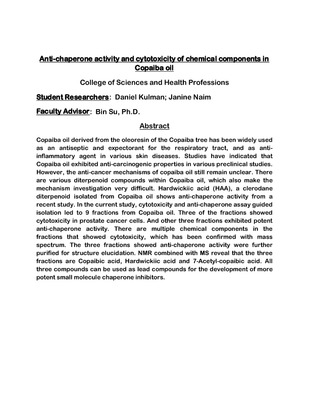
Anti-chaperone Activity and Cytotoxicity of Chemical Components in Copaiba Oil
Daniel Kulman, Janine Naim, and Bin Su Ph.D.
Copaiba oil derived from the oleoresin of the Copaiba tree has been widely used as an antiseptic and expectorant for the respiratory tract, and as anti-inflammatory agent in various skin diseases. Studies have indicated that Copaiba oil exhibited anti-carcinogenic properties in various preclinical studies. However, the anti-cancer mechanisms of copaiba oil still remain unclear. There are various diterpenoid compounds within Copaiba oil, which also make the mechanism investigation very difficult. Hardwickiic acid (HAA), a clerodane diterpenoid isolated from Copaiba oil shows anti-chaperone activity from a recent study. In the current ... Read More
-
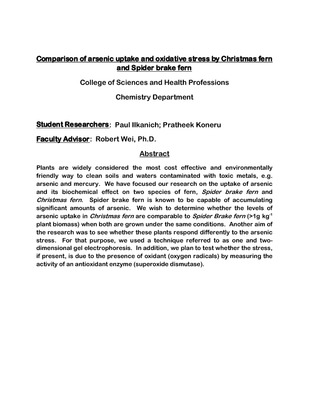
Comparison of Arsenic Uptake and Oxidative Stress by Christmas Fern and Spider Brake Fern
Paul lkanich, Pratheek Koneru, and Robert Wei
Plants are widely considered the most cost effective and environmentally friendly way to clean soils and waters contaminated with toxic metals, e.g. arsenic and mercury. We have focused our research on the uptake of arsenic and its biochemical effect on two species of fern, Spider brake fern and Christmas fern. Spider brake fern is known to be capable of accumulating significant amounts of arsenic. We wish to determine whether the levels of arsenic uptake in Christmas fern are comparable to Spider Brake fern (>1g kg-1 plant biomass) when both are ... Read More
-
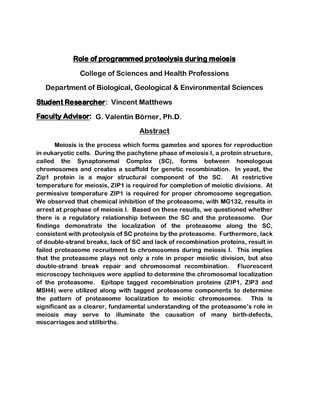
Role of Programmed Proteolysis During Meiosis
Vincent Matthews and G. Valentin Borner Ph.D.
Meiosis is the process which forms gametes and spores for reproduction in eukaryotic cells. During the pachytene phase of meiosis I, a protein structure, called the Synaptonemal Complex (SC), forms between homologous chromosomes and creates a scaffold for genetic recombination. In yeast, the Zip1 protein is a major structural component of the SC. At restrictive temperature for meiosis, ZIP1 is required for completion of meiotic divisions. At permissive temperature ZIP1 is required for proper chromosome segregation. We observed that chemical inhibition of the proteasome, with MG132, results in arrest at ... Read More
-

Atomic Force Microscopic and electrochemical study of polymeric microgels as a prototype for temperature-sensitive drug-releasing carriers
Janna Mino, Justin Flaherty, Pratheek Koneru, and Kiril A. Streletzky Ph.D.
Crosslinked hydroxypropylcellulose (HPC) form unique microgel particles that display reversible temperature-driven volume change with a critical temperature (Tc) right around values of human fever (~39oC). Heating these microgel particles above Tc results in volume contraction upon internal hydrophobic collapse and expulsion of water. HPC is FDA-approved and thus represents a perfect candidate for a drug-releasing carrier in response to systemic temperature change. This summer undergraduate subproject is one part of a cross-disciplinary project between labs of Dr. Bayachou (Chemistry) and Dr. Streletzky (Physics). The overall project uses a combination of ... Read More
-
Light Scattering and Spectrophotometry Studies of Polymeric Microgels as a Prototype for Temperature-Sensitive Drug-Releasing Carriers
Janna Mino, Justin Flaherty, Pratheek Koneru, and Kiril A. Streletzky Ph.D.
FDA approved Hydroxypropylcellulose (HPC) polymer can be cross-linked to form microgel nanoparticles that undergo a temperature dependent volume phase transition. We studied the structure and dynamics of HPC microgels and HPC polymer that microgels were made from using Dynamic (DLS) and Static Light Scattering (SLS) and Spectrophotometry. Our results determined the transition behavior of the microgels and polymer as temperatures were varied from Troom to well above the critical transition temperature TC~41ºC. The 200-250nm HPC microgels showed a reversible factor of 4-8 volume shrinkage as temperature was brought above TC. ... Read More
-
Space perception across the lifespan
Kimberly Moran, Derek Menzies, Anita Isom, and Naohide Yamamoto Ph.D.
Summary: It has recently been shown that older observers (in their 70's) judge distance to a nearby target (up to 12 m away) very accurately, while younger observers (in their 20's) significantly underestimate the same distance. Although this finding has important scientific and practical implications, more research is needed to confirm whether the observed age difference truly reflects improved accuracy in distance judgment. Importantly, it is possible that there is tendency to increasingly overestimate the distance as observers grow older, and the seemingly accurate performance exhibited by the older observers ... Read More